

Description
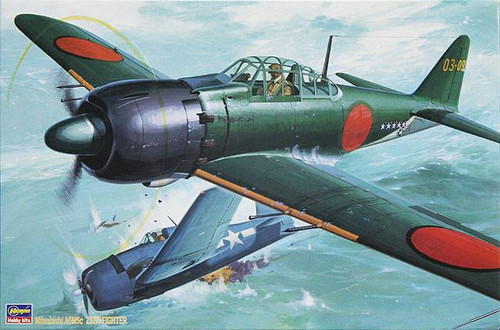
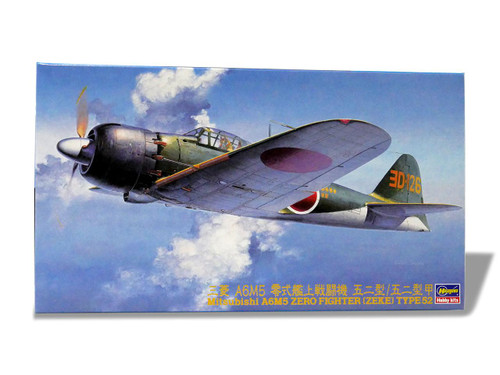
The Zero fighter, which marked the early stages of the war with victories, was a remarkable aircraft that achieved the best possible flight performance with an engine producing less than 1,000 horsepower . Because it was such an excellent aircraft, both the manufacturer and the military sought something even better, and development of the A6M3 model, including an engine change, began in early 1941, a year before the start of the Pacific War.
The development focused primarily on improving high-altitude performance through engine replacement for the manufacturer, and on improving roll rate and speed performance, as well as productivity and maintainability, by eliminating the wing folding mechanism for the military.
The engine was an improved Sakae 21 with a single-stage, two-speed supercharger , and the propeller was also a Hamilton constant-speed propeller with a 15cm larger diameter to handle the increased horsepower . While the engine performance improved, the weight increased, so the mounting points and fuselage underwent significant changes, resulting in a shorter fuselage compared to the Zero Fighter Type 21. The cowling was also redesigned to improve aerodynamic refinement, and the carburetor intake was moved from the bottom to the top. The wingtips were reshaped into a square shape and shortened by a total of 1 meter. The 20mm cannons fixed to the wings were also replaced with Type 99 Model 2 fixed guns with increased ammunition capacity.
The modified A6M3 made its maiden flight on July 14, 1941, and after numerous tests, it was adopted by the Navy as the Zero 2 Carrier Fighter Model 32, deployed to the Solomon Islands and the Southwest Pacific, where it saw active service.
These modifications improved speed and roll rate, but significantly reduced horizontal maneuverability and the Zero's characteristic range. While this wasn't much of a problem initially, the lack of range became a major issue once the long-range invasion from Rabaul to Guadalcanal began .
Therefore, a version with improved range was created, restoring the wingspan to 12 meters and adding fuel tanks inside the outer wings. This was adopted as the Zero 2nd Model Carrier Fighter Type 22 on January 29, 1943.
The Type 22 had a longer range than the Type 32, and while the Type 32 was subsequently assigned to training units despite being a newer model, the Type 22 played a leading role in air battles in the Solomon Islands. In addition, Type 22A and Type 32A versions were produced, in which the wing armament was replaced with the long-barreled Type 99 Model 2 Fixed Gun Type 3.
Specifications Mitsubishi A6M Zero Fighter Model 22:
- Crew: 1
- Wingspan: 12.00m
- Length: 9.060m
- Height: 3.570m
- Maximum Speed: 540.8km/h (at 6,000m)
- Engine: Sakae 21 (Takeoff power 1,130hp)
- Armament: 2 x 7.7mm machine guns, 2 x 20mm cannons
Specifications Mitsubishi A6M Zero Fighter Model 32
- Crew: 1
- Wingspan: 11.00m
- Length: 9.060m
- Height: 3.570m
- Maximum Speed: 544.5km/h (at 6,000m)
- Engine: Sakae 21 (Takeoff power 1,130hp)
- Armament: 2 x 7.7mm machine guns, 2 x 20mm cannon